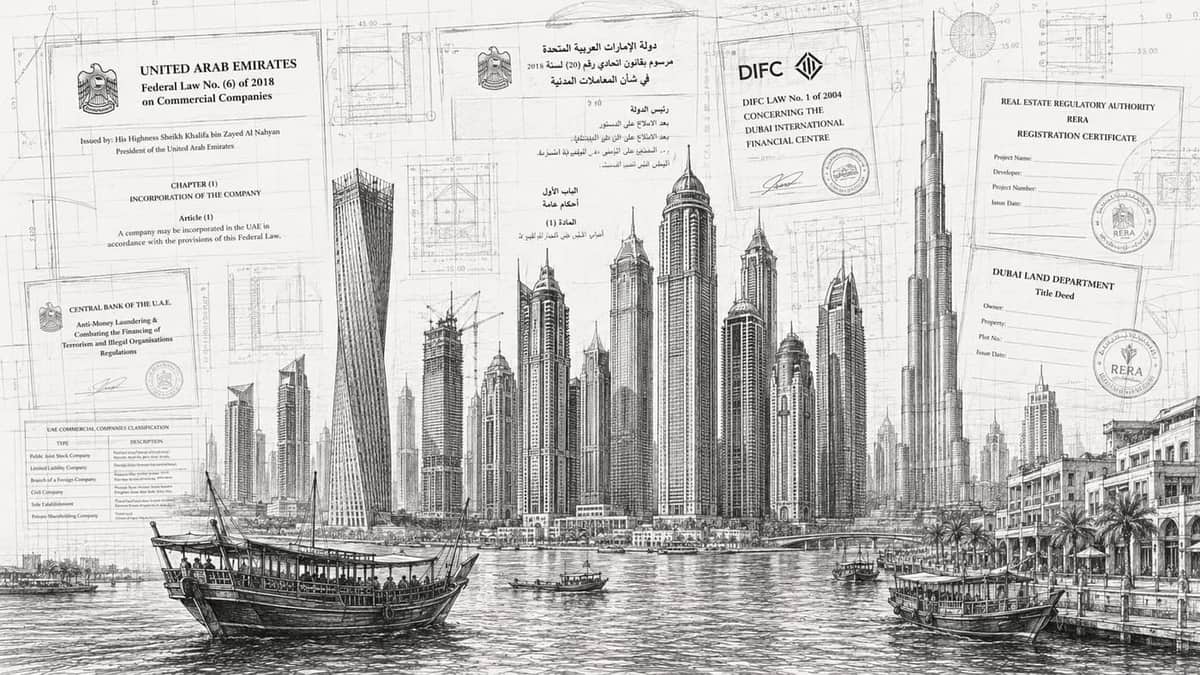
The United Arab Emirates has built one of the most sophisticated — and complex — legal environments in the world in a remarkably short period of time. For businesses operating here, that sophistication is both an opportunity and a source of genuine legal risk. Understanding the architecture of the UAE's regulatory system is not a background consideration. It is a prerequisite for operating with confidence.
A Multi-Layered Legal System
At the federal level, UAE law governs the majority of civil, commercial, criminal, and personal status matters. The Federal Civil Transactions Law, the Commercial Companies Law, the Labour Law, and the Anti-Money Laundering framework are examples of legislation that applies across all seven emirates. However, the federal layer is only the beginning.
At the emirate level, Dubai and Abu Dhabi have developed significant local regulatory frameworks — from the Dubai Land Department's oversight of property transactions to the Dubai Financial Services Authority's regulation of firms operating within the DIFC. Each emirate retains the authority to legislate on matters not exclusively reserved to the federal government, creating a patchwork of rules that can differ meaningfully from one emirate to the next.
Overlaid on this are the financial free zones — the Dubai International Financial Centre (DIFC) and the Abu Dhabi Global Market (ADGM) — which operate under distinct legal systems modelled on English common law, with their own courts, their own legislation, and their own regulatory authorities. For many international businesses, these zones offer a familiar legal environment and a high degree of contractual flexibility. But engaging with them requires understanding where they begin and where UAE onshore law ends.
Beyond DIFC and ADGM, there are over forty free zones across the UAE, each with its own licensing authority, its own restrictions on business activities, and its own interface with the wider UAE legal system. A company incorporated in one free zone is not automatically permitted to operate in another, or to conduct business directly with UAE mainland entities without the appropriate structure.
The Pace of Regulatory Change
What distinguishes the UAE from most other jurisdictions is not only the complexity of its legal architecture but the pace at which it evolves. In recent years alone, significant legislative changes have reshaped the commercial landscape:
- Amendments to the Commercial Companies Law introduced full foreign ownership of mainland companies in most sectors — a fundamental change to the onshore corporate framework.
- A comprehensive AML and counter-terrorism financing framework has been implemented and refined, with real enforcement consequences for non-compliance.
- Personal data protection legislation has been enacted at the federal level, with DIFC and ADGM maintaining their own parallel regimes.
- The real estate sector has seen continuous regulatory development, including escrow requirements, developer licensing, and strata law frameworks.
- New licensing categories and regulatory frameworks have been introduced for virtual assets, digital payments, and emerging financial services sectors.
For businesses operating in any of these areas, keeping pace with regulatory change is not optional. The consequences of non-compliance — fines, licence revocations, reputational damage, and in some cases criminal liability — are real and actively enforced.
In the UAE, precision is a legal standard. Approximate compliance is not compliance.
The Multi-Jurisdictional Dimension
International businesses face an additional layer of complexity: the interaction between UAE law and the laws of other jurisdictions in which they operate. A contract governed by English law but executed in Dubai, involving a company incorporated in the Cayman Islands — this kind of structure is common, and each element has legal implications for how disputes are resolved, how assets can be enforced against, and how regulatory obligations are allocated.
Getting this architecture right requires counsel that understands both the UAE system in depth and the points at which it interfaces with international frameworks. It also requires ongoing attention — the relationship between UAE law and international norms is itself evolving, as the UAE continues to strengthen its integration with global legal and financial systems.
Staying Ahead of Change
The businesses that navigate the UAE's regulatory environment most effectively are not those that react to change after it occurs. They are those that monitor developments, engage with legal counsel who tracks the regulatory agenda, and build compliance into their operational frameworks before obligations crystallise.
In an environment that moves as quickly as the UAE's, this is not a luxury — it is a core component of sound business management. The cost of staying current is modest. The cost of falling behind can be significant.