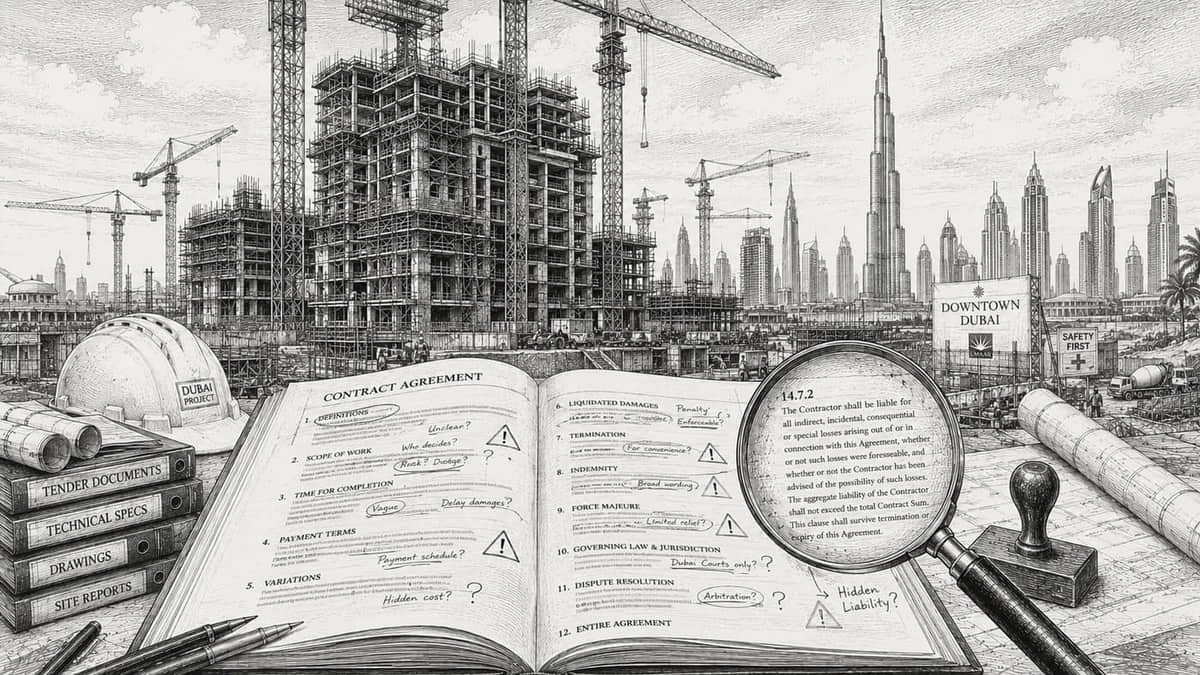
Construction contracts are among the most consequential legal documents in commercial practice — and among the most frequently reviewed inadequately before signing. The value of a major construction project, the complexity of its execution, and the duration over which obligations are performed combine to create a risk environment that standard commercial contracts rarely match.
The particular challenge of construction contracts is that their problems are deferred. A problematic clause in a service agreement may cause friction quickly. A problematic clause in a construction contract may sit dormant through months of normal performance, becoming critical only when a dispute arises — over delays, cost overruns, defects, or termination. At that point, the terms of the contract determine who bears the loss, often irrespective of what the parties believed they had agreed.
Common Risk Areas in Construction Contracts
Experienced construction lawyers look carefully at a number of provisions that are particularly prone to drafting that disadvantages one party:
- Scope of works definitions — Vague or incomplete scope definitions are among the most reliable sources of construction disputes. If the scope is unclear, disagreements about what is included — and who pays for it — are virtually guaranteed.
- Variation clauses — How changes to the scope are authorised, priced, and documented determines whether a contractor is compensated fairly for additional work, or whether scope changes become a source of loss.
- Delay provisions — What constitutes a delay, who is responsible, and what the consequences are require precise drafting. Force majeure provisions, employer-caused delays, and concurrent delay situations all need to be addressed explicitly.
- Liquidated damages — Provisions for financial penalties in the event of delay need to be carefully reviewed for their proportionality and for whether they accurately reflect a genuine pre-estimate of loss — a requirement under UAE law for enforceability.
- Payment terms — Milestone payment structures, interim payment mechanisms, retention arrangements, and the conditions for the release of final payment all require careful attention. Payment disputes are among the most common sources of construction litigation.
- Defects liability — The scope and duration of the contractor's obligation to remedy defects after practical completion, and the process for identifying and notifying defects, determine the extent of the contractor's post-completion exposure.
- Termination rights — The circumstances in which either party may terminate the contract, and the financial consequences of termination, should be clearly defined and balanced.
- Dispute resolution — Whether disputes are referred to UAE courts, DIFC courts, or arbitration — and on what terms — has significant implications for cost, duration, and the enforceability of any award.
In construction, the contract is the project's legal foundation. Build on an unstable one, and everything constructed on top of it is at risk.
Subcontractor Risks
For main contractors, the management of subcontractor relationships adds a further layer of contractual complexity. Back-to-back provisions — which seek to flow down the terms of the main contract to subcontractors — need to be carefully drafted to ensure that the risk allocation is consistent. Gaps between the main contract and subcontract terms can leave the main contractor exposed to obligations that cannot be recovered from the subcontractor responsible for the relevant work.
For subcontractors, the risk profile is different but equally real. Standard subcontract terms are typically prepared by the main contractor and reflect the main contractor's interests. Independent legal review before accepting a subcontract can identify provisions that are disproportionately onerous and create opportunities to negotiate more balanced terms.
When Disputes Arise
Despite the best preparation, construction disputes do arise. The UAE has a well-developed body of construction law, and both the onshore courts and the DIFC and ADGM courts have significant experience of complex construction claims. Arbitration — particularly through the Dubai International Arbitration Centre — is also a frequently used mechanism for resolving major construction disputes.
Effective dispute resolution in construction matters requires legal counsel with a detailed understanding of the contract, the factual record of the project, and the applicable legal framework. Contemporaneous documentation — correspondence, variation orders, delay notices, and payment records — is critical. Parties that have maintained good records are substantially better positioned than those who have not.
The Right Time to Review
The right time to review a construction contract is before it is signed. At that stage, there is an opportunity to identify problematic provisions, negotiate amendments, and ensure that the document accurately reflects the deal the parties intend to make. Once a project is underway and a dispute has arisen, the legal framework is fixed — and the role of counsel shifts to working within it, rather than shaping it.
For any significant construction project, the cost of a thorough contract review before signing is modest relative to the values at stake — and relative to the cost of resolving disputes that inadequate contracts make more likely.